Fingerprint smart door locks are becoming increasingly popular in modern homes, apartments, hotels, and commercial buildings. Unlike traditional key locks, which rely on physical keys, fingerprint smart locks use biometric recognition technology to identify authorized users and control door access.
But are fingerprint smart door locks actually more secure than traditional key locks? The answer depends on the lock’s design, authentication technology, mechanical construction, and overall security features.
Let’s compare the two types of locks and explore what homeowners should consider before choosing one.
1. How Do Fingerprint Smart Door Locks Work?
Fingerprint smart door locks use biometric sensors to recognize a user’s unique fingerprint. During registration, the system captures fingerprint characteristics and stores a digital template for future identification.
When someone places their finger on the scanner, the lock compares the fingerprint with its stored templates. If the fingerprint matches an authorized user, the electronic mechanism unlocks the door.
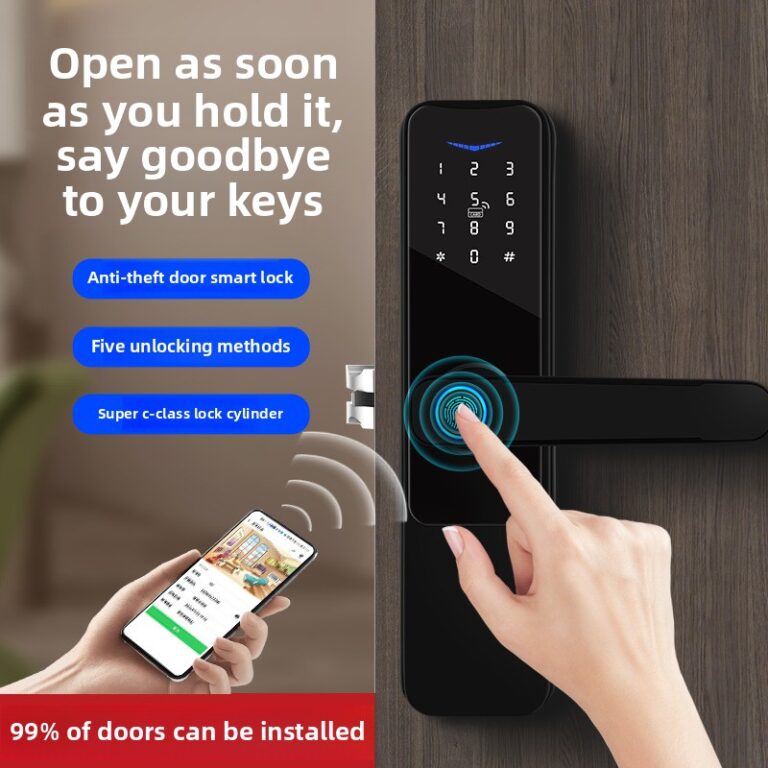
Most modern fingerprint smart locks also support multiple unlocking methods, including:
-
Fingerprint recognition
-
PIN code access
-
Smartphone Bluetooth unlocking
-
WiFi remote access
-
RFID cards
-
Mechanical emergency keys
This multi-access design provides greater convenience and flexibility than traditional key locks.
2. How Secure Are Traditional Key Locks?
Traditional key locks have been used for decades and remain a reliable security solution.
Their security mainly depends on the cylinder design, internal pin mechanism, material quality, and resistance to physical attacks.
However, traditional locks have several potential weaknesses:
-
Lock picking: Some conventional cylinders can be manipulated using specialized tools.
-
Key duplication: Unauthorized copies may be made if someone obtains access to the original key.
-
Lost keys: Losing a key can create a security risk.
-
Bumping attacks: Certain pin-tumbler locks may be vulnerable to lock bumping.
-
Limited access management: Traditional locks cannot easily track who enters or leaves.
High-security mechanical locks can provide excellent protection, but basic models may lack advanced security features.
3. Fingerprint Smart Locks vs. Traditional Key Locks
The following table compares their major security characteristics.
|
Security Feature |
Fingerprint Smart Lock |
Traditional Key Lock |
|---|---|---|
|
Keyless access |
Yes |
No |
|
Fingerprint authentication |
Yes |
No |
|
Lock picking resistance |
Depends on cylinder |
Depends on cylinder |
|
Key duplication risk |
No physical key required for fingerprint access |
Possible |
|
PIN code protection |
Available on many models |
No |
|
Remote access management |
Available on WiFi models |
No |
|
Entry records |
Available on selected models |
No |
|
Battery dependence |
Yes |
No |
|
Emergency mechanical access |
Available on selected models |
Standard |
|
Multiple user management |
Yes |
Limited |
Fingerprint smart locks offer more authentication and access-management options, while traditional locks have the advantage of simpler mechanical operation.
4. What Makes Fingerprint Smart Door Locks More Secure?
Several technologies can improve the security of fingerprint smart door locks.
Biometric Authentication
Fingerprint recognition makes it unnecessary to carry a physical key. Authorized users can unlock the door using registered fingerprints.
Anti-Peeping PIN Codes
Some smart locks support virtual passwords. Users can enter additional random digits before or after their actual password to make it harder for someone to observe the correct code.
Anti-Tamper Alarms
Advanced models can trigger an alarm when someone attempts unauthorized access, damages the lock, or repeatedly enters incorrect passwords.
Automatic Locking
Automatic locking helps prevent doors from remaining unlocked accidentally after someone enters or leaves.
Access Management
Administrators can register or delete fingerprints, change passwords, and manage access permissions without replacing the entire lock.
These features make smart locks particularly useful for households with multiple family members, rental properties, and commercial environments.
5. Can Fingerprint Smart Locks Be Hacked?
Yes. Like other electronic security devices, fingerprint smart locks may have vulnerabilities.
Potential risks include:
-
Poorly designed fingerprint recognition systems.
-
Weak PIN codes.
-
Insecure Bluetooth or WiFi communication.
-
Outdated firmware.
-
Unauthorized access to connected mobile applications.
-
Low-quality electronic components.
However, these risks can be reduced by choosing products with reliable biometric sensors, encrypted communication, secure firmware, and appropriate authentication mechanisms.
Buyers should also check whether the lock has undergone independent security testing.
6. Can Fingerprint Smart Locks Be Opened Without a Fingerprint?
Yes. Most fingerprint smart door locks provide alternative unlocking methods in case the fingerprint sensor fails or the battery runs out.
Common backup methods include:
-
Emergency mechanical keys.
-
Backup PIN codes.
-
External emergency power connections.
-
Authorized smartphone access, depending on the model and power configuration.
These backup options help ensure that users can still access their homes during unexpected situations.
When purchasing a smart lock, it is important to check its emergency unlocking design and battery warning system.
7. Which Is Better for Home Security?
The best choice depends on your security requirements, budget, and daily usage.
|
Application |
Recommended Option |
|---|---|
|
Modern residential homes |
Fingerprint smart locks |
|
Apartments with multiple residents |
Fingerprint smart locks |
|
Rental properties |
Smart locks with access management |
|
Basic low-cost installations |
Traditional key locks |
|
Locations without reliable electricity |
Traditional key locks or battery-powered smart locks |
|
Businesses requiring access records |
Smart locks with audit logs |
For most modern homes, a high-quality fingerprint smart door lock provides a better combination of convenience, access control, and security management.
However, biometric technology alone does not guarantee better physical security. The deadbolt, lock cylinder, door frame, installation quality, and anti-forced-entry construction are equally important.
8. How to Choose a High-Security Fingerprint Smart Door Lock?
Before purchasing a fingerprint smart lock, consider these important factors:
-
Fingerprint accuracy: Choose a reliable biometric recognition system with good performance under different environmental conditions.
-
Mechanical protection: Look for a strong deadbolt, durable lock body, and high-quality cylinder.
-
Data security: Check whether fingerprint data and wireless communications are properly protected.
-
Multiple unlocking methods: Consider fingerprint, password, RFID, smartphone, and emergency key options.
-
Battery performance: Check battery life, low-battery warnings, and emergency power support.
-
Security certifications: Look for relevant independent testing and certifications for the intended market.
-
After-sales support: Ensure that replacement components, technical support, and warranty services are available.
A well-designed smart lock should combine reliable electronic authentication with strong mechanical protection.
9. Conclusion: Are Fingerprint Smart Door Locks More Secure?
Fingerprint smart door locks can offer better overall access management and convenience than traditional key locks. They eliminate many risks associated with lost or duplicated keys and provide additional features such as biometric authentication, PIN protection, automatic locking, and entry monitoring.
Nevertheless, not every fingerprint smart lock is automatically more secure than a traditional mechanical lock.
The best solution is to choose a smart lock that combines accurate fingerprint recognition, strong mechanical construction, secure electronic systems, and reliable emergency unlocking methods.
Discover Reliable Smart Door Lock Solutions – SUiK Smart Lock
If you are looking for modern fingerprint smart door locks for residential, commercial, or distribution applications, SUiK Smart Lock offers a range of smart locking solutions designed to meet different market requirements.
Visit SUiK Smart Lock to explore smart door lock products and discover solutions featuring fingerprint recognition, password access, RFID cards, Bluetooth connectivity, and other intelligent access technologies.
Whether you are a homeowner, property developer, wholesaler, or smart lock distributor, choosing the right combination of electronic technology and mechanical security is essential for protecting every entrance.