Smart locks have become an increasingly popular choice for homeowners, apartment residents, hotels, and commercial property managers. Among the most common wireless smart lock technologies are WiFi and Bluetooth. Both allow users to unlock doors without traditional keys, but they differ in connectivity, remote access, power consumption, security features, and everyday convenience.
Understanding the difference between WiFi smart locks and Bluetooth smart locks can help you choose the right solution for your home or business.
1. What Is a WiFi Smart Lock?
A WiFi smart lock connects to your home’s wireless network, allowing users to control and monitor the door remotely through a smartphone application.
As long as the smart lock has an internet connection, users can manage access even when they are away from home.
Key Features of WiFi Smart Locks:
-
Remote Access: Lock or unlock your door from almost anywhere using an internet-connected smartphone.
-
Real-Time Notifications: Receive alerts when someone unlocks or locks the door.
-
Access Management: Create temporary passwords or digital access permissions for family members, guests, and service providers.
-
Smart Home Integration: Some models support Amazon Alexa, Google Home, and other smart home platforms.
-
Activity Monitoring: Check door lock activity and access records through a mobile application.
WiFi smart locks are particularly suitable for homeowners who frequently travel, property managers, and people who need to manage door access remotely.
2. What Is a Bluetooth Smart Lock?
A Bluetooth smart lock communicates directly with a smartphone using Bluetooth wireless technology. Users can unlock the door through a mobile application when they are within the supported Bluetooth communication range.
Unlike WiFi smart locks, Bluetooth smart locks generally do not require a permanent internet connection for basic smartphone unlocking.
Key Features of Bluetooth Smart Locks:
-
Local Smartphone Control: Unlock the door directly using a Bluetooth-enabled smartphone.
-
No WiFi Required: Basic Bluetooth unlocking works without a home WiFi network.
-
Lower Power Consumption: Bluetooth Low Energy (BLE) technology helps extend battery life.
-
Fast Communication: Provides convenient short-range communication between the smartphone and lock.
-
Convenient Daily Access: Users can unlock their doors when they approach the entrance, depending on the lock’s features.
Bluetooth smart locks are ideal for apartments, bedrooms, offices, and homes where users primarily need local access control.
3. WiFi Smart Locks vs Bluetooth Smart Locks: Key Differences
Although both technologies provide keyless entry, their practical applications are different.
| Feature | WiFi Smart Locks | Bluetooth Smart Locks |
|---|---|---|
| Connectivity | WiFi network | Bluetooth |
| Operating Range | Remote access via internet | Short-range communication |
| Remote Unlocking | Usually supported | Usually requires additional gateway |
| Internet Requirement | Required for remote functions | Not required for basic unlocking |
| Power Consumption | Generally higher | Generally lower |
| Battery Life | Often shorter | Often longer |
| Real-Time Alerts | Remote notifications | Usually local or gateway-dependent |
| Installation | May require WiFi configuration | Usually straightforward |
| Smart Home Integration | Broad remote integration options | Depends on lock and ecosystem |
| Best Application | Remote access management | Local smartphone access |
One important point: Some smart locks combine WiFi and Bluetooth technologies, offering both local unlocking and remote management.

4. Which Smart Lock Has Better Battery Life?
Battery life is an important consideration when purchasing an electronic smart door lock.
Bluetooth smart locks typically consume less power because Bluetooth Low Energy is designed for efficient wireless communication. This makes them suitable for battery-powered door locks that need to operate for extended periods.
WiFi smart locks generally consume more power because maintaining a WiFi connection requires additional energy.
However, actual battery performance depends on several factors:
-
Wireless communication frequency.
-
Number of daily unlocking operations.
-
Motor power consumption.
-
Battery capacity and quality.
-
Environmental temperature.
-
Standby power management.
If long battery life is your priority, a Bluetooth smart lock may be a better choice. However, some modern WiFi smart locks also feature advanced power-saving technologies.
5. Which Is More Secure: WiFi or Bluetooth Smart Locks?
Both WiFi and Bluetooth smart locks can provide strong security when designed and configured correctly.
Their security depends more on encryption, authentication, firmware updates, and access management than on the wireless technology alone.
WiFi Smart Lock Security
-
Encrypted communication between the lock and connected services.
-
Secure smartphone account authentication.
-
Remote access monitoring and notifications.
-
Firmware updates to address potential vulnerabilities.
Bluetooth Smart Lock Security
-
Encrypted Bluetooth communication.
-
Smartphone authentication.
-
Secure digital key management.
-
Local access control without requiring continuous internet connectivity.
For either type, buyers should look for strong encryption, secure authentication, automatic locking, anti-tampering protection, and reliable firmware updates.
6. Can a Bluetooth Smart Lock Be Controlled Remotely?
A standard Bluetooth smart lock usually cannot be controlled remotely when the user is outside Bluetooth communication range.
However, some manufacturers offer a WiFi gateway that connects the Bluetooth lock to the internet.
With a compatible gateway, users may be able to:
-
Unlock and lock doors remotely.
-
Monitor door status.
-
Receive remote access notifications.
-
Manage digital keys through a mobile application.
This makes Bluetooth smart locks more flexible without requiring every lock to have built-in WiFi connectivity.
7. Which Smart Lock Should You Choose?
The best choice depends on your property, usage habits, and access management requirements.
Choose a WiFi Smart Lock If:
-
You need to unlock your door remotely.
-
You frequently travel or work away from home.
-
You manage rental properties or multiple users.
-
You want real-time notifications and remote access management.
-
You want integration with internet-connected smart home systems.
Choose a Bluetooth Smart Lock If:
-
You primarily unlock your door when you are nearby.
-
You want to reduce wireless power consumption.
-
You do not want to depend on a home WiFi network.
-
You prefer straightforward local smartphone access.
-
You want a convenient solution for apartments or offices.
Consider a Hybrid Smart Lock If:
You want both local Bluetooth unlocking and remote WiFi access. A hybrid smart lock can combine the advantages of both technologies, depending on its hardware and gateway configuration.
8. What Other Features Should You Consider When Buying a Smart Lock?
Wireless connectivity is only one factor when selecting a smart door lock. Buyers should also evaluate the following features:
-
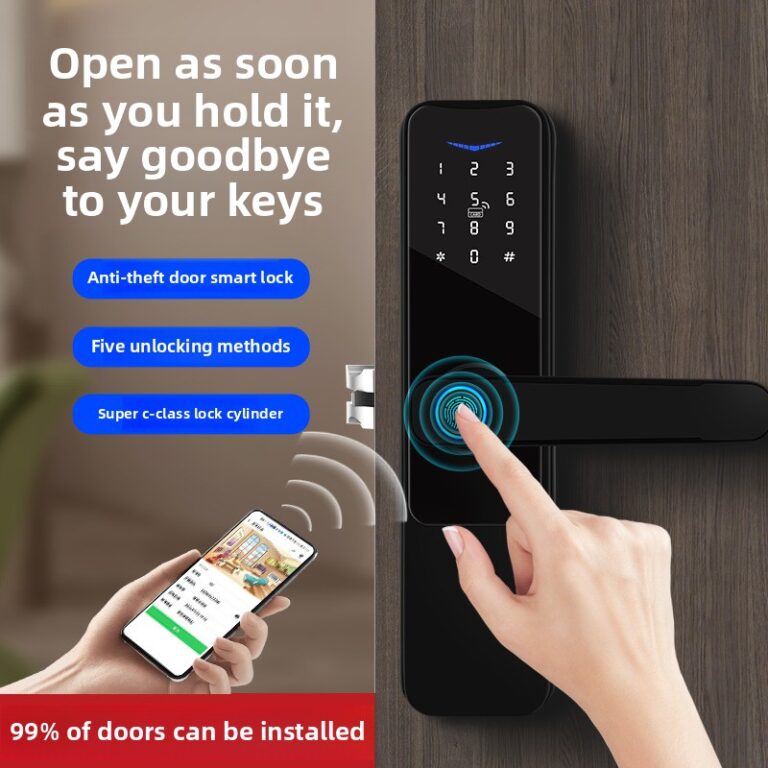
Fingerprint Recognition: Provides convenient biometric access.
-
Password Keypad: Allows entry using PIN codes.
-
IC Card Access: Suitable for families, offices, and hotels.
-
Mechanical Key Backup: Provides an alternative unlocking method.
-
Anti-Peeping Password: Helps prevent others from identifying your actual PIN.
-
Low Battery Alerts: Reminds users to replace or recharge batteries.
-
Automatic Locking: Locks the door automatically after closing.
-
Multiple User Management: Allows administrators to manage different access permissions.
Choosing a smart lock with multiple unlocking methods can provide greater flexibility and convenience for different users.
9. Conclusion: WiFi vs Bluetooth Smart Locks
WiFi smart locks are generally better for remote access, real-time monitoring, and smart home integration. Bluetooth smart locks are more suitable for local smartphone unlocking, lower power consumption, and applications that do not require continuous internet connectivity.
There is no universally better option. The right choice depends on how you use your door and which functions matter most.
If you are looking for reliable smart door lock solutions, Suik Smart Lock offers smart locking products designed for modern residential and commercial applications.
Visit Suik Smart Lock to explore different smart door lock options and discover solutions featuring fingerprint recognition, password access, Bluetooth connectivity, WiFi control, and other convenient unlocking technologies.